 +13692363966
 NEWSLETTER

Introduction
When people think about residential solar energy, they usually focus on solar panels.
However, the solar inverter is just as important as the panels themselves.
Solar panels generate direct-current electricity (DC), while most household appliances use alternating-current electricity (AC). The inverter performs the critical job of converting the electricity into a form that the home can use.
In modern solar systems, the inverter can do much more than simple DC-to-AC conversion. Depending on the type, it can manage batteries, monitor energy production, provide backup power, control energy flow, and communicate with other components.
Choosing the right solar inverter for home use is therefore essential for building an efficient, reliable, and expandable solar energy system.
This comprehensive guide explains the different types of solar inverters, how they work, how to size one, how they interact with batteries and solar panels, what features homeowners should look for, common mistakes to avoid, and how to maintain an inverter throughout its service life.

What Is a Solar Inverter?
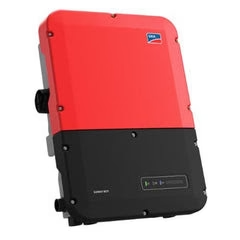
A solar inverter is an electrical device that converts the DC electricity generated by solar panels into AC electricity used by household appliances.
The basic process is:
Solar panels → DC electricity → Solar inverter → AC electricity → Home
Without an appropriate inverter, electricity generated by standard solar panels cannot directly operate most household AC appliances.
Why Is the Solar Inverter Important?
The inverter is essentially the control center of many solar energy systems.
It can determine:
- How solar electricity is converted
- How much power is delivered to the home
- How batteries are charged
- How batteries are discharged
- Whether backup power is available
- How the system communicates with monitoring software
A high-quality solar panel connected to an incorrectly designed inverter system may not perform as expected.


How Does a Solar Inverter Work?
Solar panels generate electricity as DC power.
The inverter receives that electricity and converts it into AC power.
Modern inverters also continuously monitor electrical conditions.
Depending on the design, the inverter may:
- Receive electricity from solar panels.
- Track the panels’ operating point.
- Convert DC electricity to AC electricity.
- Supply household loads.
- Charge a battery.
- Export excess electricity where permitted.
- Draw electricity from the grid when necessary.
What Is MPPT?
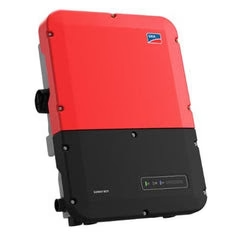
One of the most important inverter features is Maximum Power Point Tracking, commonly called MPPT.
Solar panels do not produce exactly the same voltage and current under every condition.
Their output changes according to:
- Sunlight
- Temperature
- Panel characteristics
- Shading
MPPT technology allows the inverter to continually adjust its operating point to extract useful power from the solar array.
Why MPPT Matters
Suppose one section of a roof receives strong sunlight while another section receives more shade.
If the panels are connected incorrectly, shading can affect the performance of the array.
Having appropriate MPPT inputs can help the inverter manage different panel groups more effectively.
This is particularly important for homes with complex roofs.
Types of Solar Inverters
There are several types of residential solar inverter systems.
The major categories include:
- String inverters
- Microinverters
- Hybrid inverters
- Off-grid inverters
- Battery inverters
Each has different advantages and applications.
String Inverter
A string inverter connects multiple solar panels together into strings.
The electricity from the panels is sent to a central inverter.
The basic configuration is:
Solar panels → String → Inverter → Home
String inverters are widely used because they can provide a relatively straightforward system architecture.
Advantages of String Inverters
Potential advantages include:
- Centralized equipment
- Straightforward installation
- Easier system design
- Common availability
- Potentially lower equipment cost
They can be particularly suitable for roofs with relatively uniform sunlight exposure.
Disadvantages of String Inverters
Potential disadvantages include:
- Shading can affect string performance
- A single central inverter represents a major system component
- Different roof orientations may require careful design
These issues can sometimes be addressed with multiple MPPT inputs or other system configurations.
Microinverters
Microinverters are installed at or near individual solar panels.
Instead of sending DC electricity from several panels to one central inverter, each panel has its own conversion device.
The system therefore looks more like:
Panel → Microinverter → AC electricity
Advantages of Microinverters
Microinverters can offer:
- Panel-level power conversion
- Panel-level monitoring
- Flexibility for complex roofs
- Reduced impact from some shading conditions
- Easier expansion in certain designs
They can be useful when different panels experience different amounts of sunlight.
Disadvantages of Microinverters
Potential disadvantages include:
- More electronic devices installed on the roof
- More components
- Potentially higher equipment costs
- Different maintenance considerations
The best choice depends on the property and system design.
Hybrid Solar Inverter
A hybrid inverter combines solar and battery-management functions.
It can manage energy between:
- Solar panels
- Home
- Battery
- Grid
A typical hybrid system operates like:
Solar → Home
and:
Solar → Battery
and later:
Battery → Home
The grid can also participate when necessary.
Why Are Hybrid Inverters Popular?
Hybrid inverters are particularly attractive for homeowners who want:
- Solar energy
- Battery storage
- Backup power
- Energy management
They can simplify system architecture by allowing one inverter platform to manage multiple energy sources.
Off-Grid Solar Inverter
Off-grid inverters are designed for systems that operate without a conventional utility grid.
They typically work with:
- Solar panels
- Batteries
- Household loads
Because there is no grid available to provide backup electricity, the inverter must carefully manage energy availability.
Battery Inverter
A battery inverter manages electricity flowing between a battery and AC loads.
Depending on the system, battery functions may be integrated into a hybrid inverter or handled by a separate device.
Grid-Tied Solar Inverter
A grid-tied inverter is designed to operate with the electrical grid.
It converts solar electricity into AC power and synchronizes its output with the grid.
One important feature is that a standard grid-tied system generally shuts down during a grid outage.
This prevents electricity from being sent into a grid that utility workers may believe is de-energized.
Solar Inverter vs Hybrid Inverter
The main difference is battery capability.
A basic grid-tied solar inverter primarily manages:
Solar → Home/Grid
A hybrid inverter can manage:
Solar ↔ Battery ↔ Home/Grid
If battery storage is part of your long-term plan, a hybrid inverter may provide greater flexibility.
How to Size a Solar Inverter
Inverter sizing depends on:
- Solar panel capacity
- Household demand
- Battery capacity
- Panel voltage
- Panel current
- Desired backup output
- Inverter specifications
Do not select an inverter simply because its advertised kW rating looks similar to the panel capacity.
The DC input specifications must also match the solar array.
Solar Array Size vs Inverter Size
The solar array and inverter do not always have to have exactly the same rated capacity.
Depending on the manufacturer’s specifications and system design, the DC solar array can sometimes be larger than the inverter’s AC output capacity.
However, the inverter’s maximum input limits must never be exceeded.
This is one reason professional system design is important.
Example of Inverter Sizing
Imagine a home has:
6kW of solar panels
and is considering an inverter with:
5kW AC output
This could potentially be an appropriate design depending on the manufacturer’s allowable DC/AC ratio and the property’s solar conditions.
However, the exact answer depends on the inverter specifications.
How Much Inverter Power Does a Home Need?
Look at your maximum expected electrical demand.
For example, if you regularly operate:
- Refrigerator
- Freezer
- Television
- Fans
- Lights
- Computers
- Water pump
- Air conditioner
at the same time, the inverter must be capable of supplying the combined demand.
You should also account for startup surges from certain appliances.
Continuous Power vs Surge Power
Two inverter specifications are particularly important.
Continuous Power
The amount of power the inverter can supply continuously.
Surge Power
The additional power the inverter can provide temporarily when certain appliances start.
This is particularly important for motors and compressors.
Why Startup Power Matters
Some appliances have motors that require more power when starting than when operating normally.
Examples include:
- Refrigerators
- Freezers
- Water pumps
- Air conditioners
If the inverter cannot handle the startup demand, the appliance may fail to start or the inverter may shut down.
Solar Inverter Efficiency
No inverter converts electricity with 100% efficiency.
Some energy is lost during conversion.
When comparing inverters, efficiency is an important specification.
However, efficiency should not be considered alone.
Also evaluate:
- Reliability
- Warranty
- Battery compatibility
- Monitoring
- Service support
- Operating temperature
- Input range
Solar Inverter Operating Temperature
Inverters generate heat during operation.
They therefore need an appropriate installation location.
Avoid placing an inverter in an excessively hot or poorly ventilated environment unless the manufacturer specifically permits it.
High temperatures can affect equipment performance and lifespan.
Where Should a Solar Inverter Be Installed?
Possible locations include:
- Garage
- Utility room
- Electrical room
- Protected exterior wall
The installation site should provide appropriate:
- Ventilation
- Clearance
- Protection from moisture
- Accessibility
- Temperature control
Always follow the manufacturer’s installation instructions.
Solar Inverter Monitoring
Modern inverters often provide digital monitoring.
Depending on the system, homeowners may be able to view:
- Solar generation
- Current power output
- Daily production
- Monthly production
- Battery state of charge
- Grid consumption
- Exported electricity
- Fault codes
Monitoring is useful for identifying changes in system performance.
What Happens When the Grid Goes Down?
For a conventional grid-tied inverter, the system generally stops producing usable grid-connected AC power during an outage.
This is a safety feature.
If backup power is required, the system needs equipment specifically designed to isolate the home from the grid and create a local electrical supply.
Solar Inverter With Battery Backup
A hybrid inverter can coordinate solar panels and battery storage.
During normal operation:
Solar → Home + Battery
During the evening:
Battery → Home
During an outage:
Battery → Backup Loads
If solar production continues and the system supports it:
Solar → Home + Battery
This can provide greater energy resilience.
Solar Inverter and Battery Compatibility
Before purchasing a battery, verify:
- Battery voltage
- Supported chemistry
- Maximum charging current
- Maximum discharge current
- Communication protocol
- Supported battery models
Never assume that two devices are compatible simply because both are labeled as solar equipment.
Can One Inverter Handle Solar and Batteries?
Yes, a hybrid inverter can potentially manage both.
However, the exact capabilities depend on the model.
Some hybrid inverters can support:
- Solar input
- Battery charging
- Grid interaction
- Backup output
- Energy monitoring
Others may have different limitations.
Solar Inverter for Off-Grid Homes
Off-grid homes require an inverter designed to create a stable AC supply without depending on the utility grid.
The inverter must coordinate:
- Solar production
- Battery state
- Household demand
If consumption becomes too high, the system may shut down or disconnect certain loads.
Proper load management is therefore essential.
Solar Inverter for Large Homes
Large homes may require higher inverter capacity.
High electrical loads could include:
- Multiple air conditioners
- Electric cooking
- Large pumps
- Water heating
- Pool equipment
- Electric vehicles
In some cases, multiple inverters may be used rather than one very large unit.
Multiple Inverter Systems
Using multiple inverters can provide:
- Greater total power
- Redundancy
- Expansion flexibility
- Separate system zones
However, multiple-inverter systems require careful design and configuration.
Solar Inverter Maintenance
Inverters generally require relatively little routine maintenance.
Homeowners should monitor:
- Error messages
- Temperature
- Unusual noises
- Unexpected shutdowns
- Solar production
Keep the inverter area clear and follow the manufacturer’s maintenance recommendations.
Signs Your Solar Inverter May Have a Problem
Potential warning signs include:
- Frequent shutdowns
- Unexpected fault codes
- Sudden production drops
- Excessive heat
- Unusual sounds
- Communication failures
- Battery connection errors
If the system behaves abnormally, contact a qualified technician.
Do not open the inverter yourself unless you are appropriately qualified.
Solar Inverter Lifespan
The service life of an inverter varies according to:
- Product quality
- Operating temperature
- Usage
- Installation environment
- Maintenance
Because the inverter may have a different lifespan from the solar panels, homeowners should consider potential inverter replacement during the overall life of the solar system.
Solar Inverter Warranty
When purchasing an inverter, review:
- Warranty length
- Parts coverage
- Labor coverage
- Replacement process
- Conditions that could invalidate the warranty
A longer warranty can provide additional protection, but warranty terms matter more than the headline duration alone.
How to Choose the Best Solar Inverter for Your Home
Consider these factors:
1. System Size
Make sure the inverter can support the planned solar array.
2. Household Load
Make sure the inverter can handle expected electricity demand.
3. Battery Requirements
If you want batteries, confirm compatibility.
4. Backup Requirements
Determine whether you need outage protection.
5. Monitoring
Look for useful monitoring features.
6. Warranty
Review the full warranty conditions.
7. Expansion
Consider whether you may add panels or batteries later.
8. Installation Environment
Ensure the inverter is suitable for your local temperature and installation location.
Common Solar Inverter Mistakes
Choosing Based Only on Price
The cheapest inverter may not offer the best long-term value.
Ignoring Surge Capacity
Large motor-driven appliances may require substantial startup power.
Using an Incompatible Battery
Always verify compatibility.
Installing in a Hot Location
Excessive heat can negatively affect equipment.
Ignoring Future Expansion
A system designed with no expansion capacity may become difficult to upgrade.
Oversizing Without Checking Specifications
Every inverter has maximum input limits.
Frequently Asked Questions
What does a solar inverter do?
It converts DC electricity from solar panels into AC electricity used by household appliances.
Is a solar inverter necessary?
For a conventional residential solar system supplying AC household loads, an appropriate inverter or inverter-based architecture is necessary.
What is the difference between a solar inverter and a hybrid inverter?
A basic solar inverter primarily converts solar electricity, while a hybrid inverter can also manage battery storage and other energy sources.
Can a solar inverter work without batteries?
Yes. Many grid-tied solar systems operate without batteries.
Can an inverter power my entire house?
It can if its continuous and surge power ratings are sufficient for the household loads and the electrical system is designed appropriately.
What happens if the inverter is too small?
It may limit available power or shut down when household demand exceeds its capabilities.
Can I use a larger inverter than my solar panels?
It depends on the system design. A large inverter does not automatically improve solar production. The inverter and solar array should be properly matched.
How long does a solar inverter last?
Service life varies by equipment, environment, and operating conditions.
Final Conclusion
The solar inverter for your home is one of the most important decisions you will make when designing a residential solar energy system.
Solar panels generate electricity, but the inverter determines how that electricity is converted, controlled, monitored, and—when using a hybrid system—stored and delivered.
When selecting an inverter, consider:
Solar capacity + household demand + battery requirements + backup needs + compatibility + warranty + future expansion
Do not choose an inverter simply because it has a familiar brand name or a low price.
Instead, choose equipment that is correctly matched to the entire solar system.
A properly sized and professionally installed inverter can improve system reliability, support efficient energy management, provide battery integration, and help your solar installation deliver dependable performance for years to come.